

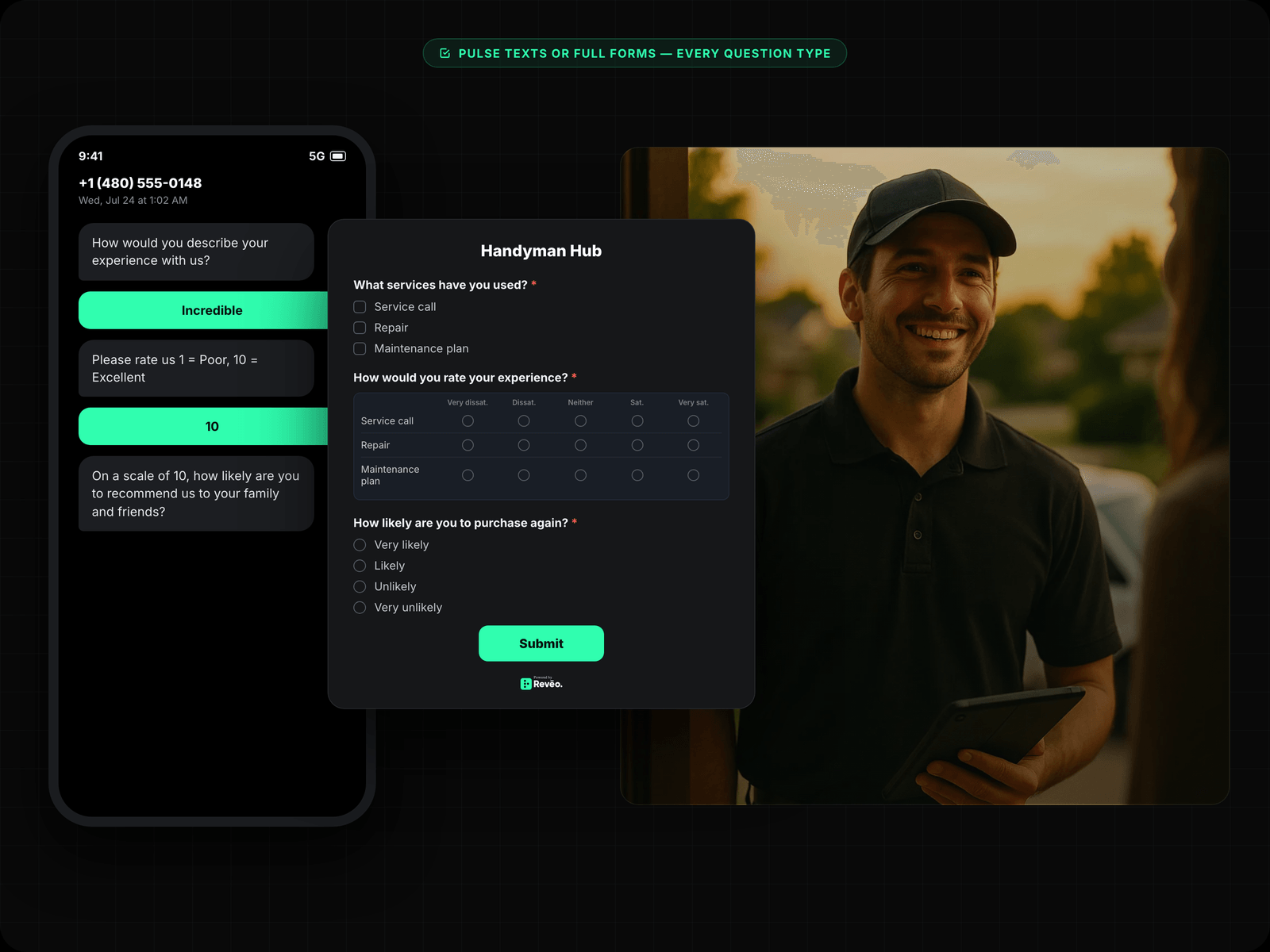
Net Promoter Score (NPS) is a loyalty metric built on one question: how likely are you to recommend us, on a scale of 0 to 10. You subtract the share of unhappy customers from the share of enthusiastic ones, and the result — somewhere between -100 and +100 — is your NPS.
That’s the whole thing. Fred Reichheld introduced it in a 2003 Harvard Business Review article called “The One Number You Need to Grow,” and it stuck because it’s simple enough that a plumbing company with no marketing department can run it. Here’s what the score actually tells you, how to calculate it, and where it earns its keep for a service business — plus where it doesn’t.
How NPS actually works
You ask every customer one question after the job: “On a scale of 0 to 10, how likely are you to recommend us to a friend or neighbor?” Then you bucket the answers.
- Promoters (9–10) — the customers who’ll actually send you referrals and leave reviews.
- Passives (7–8) — satisfied but not loyal. They liked you fine. They’ll also switch for a coupon.
- Detractors (0–6) — unhappy. Left alone, these are the people writing the one-star review and telling their neighbor to call someone else.
The math ignores the passives entirely. NPS = the percentage of promoters minus the percentage of detractors. Say 100 customers answer: 60 give you a 9 or 10, 25 give you a 7 or 8, and 15 give you a 6 or below. Your NPS is 60% minus 15%, or +45. A score can technically run from -100 (everyone hates you) to +100 (everyone loves you), but in the real world anything above zero means more fans than critics.
What counts as a good score
There’s no universal pass mark, and anyone who quotes you a magic number is guessing. Scores vary wildly by industry and by how you collect them. A useful rule of thumb: positive is fine, the 40s to 60s is strong for home services, and above that is excellent.
The number in isolation is close to useless, though. What matters is the direction. An NPS of +38 that was +30 last quarter is a business getting better. An NPS of +55 sliding toward +45 is an early warning that something’s slipping — a crew that’s rushing jobs, a scheduling system that’s dropping people, a phone that isn’t getting answered. Bain & Company, where NPS originated, found that the companies leading their industries on Net Promoter grew at more than twice the rate of competitors. Loyalty compounds. Track your own trend and stop comparing yourself to a benchmark you can’t verify.
Where NPS helps — and where it falls short
The honest version: NPS is a great smoke alarm and a poor diagnostic.
The one-question format is its strength. Response rates on a single tap-to-answer question crush long surveys, because you’re asking for five seconds, not five minutes. You get a real, trackable pulse on loyalty without building a research operation. For a busy operator, that simplicity is the point.
The weakness is that a number tells you that someone’s unhappy, never why. A 3 is a signal, not an explanation. So the score alone can’t fix anything — it just tells you where to look. That’s why NPS on its own is a mistake. Always pair the 0–10 question with one open follow-up: “What’s the main reason for your score?” That single text box is where the actual value lives. The 3 becomes “your tech was two hours late and didn’t call,” and now you have something you can fix.
If you want to go deeper than loyalty into the specifics of the job, a fuller customer satisfaction survey that asks about scheduling, communication, and the work itself does more diagnostic work. NPS tells you the temperature; a satisfaction survey tells you which room is on fire.
How to run an NPS survey people actually answer
Timing beats everything. Send the survey right after the job is done, while the customer still remembers the tech’s name and the yard still looks great. A quarterly NPS blast to your whole list gets ignored, because the customer is being asked to grade a service they got two months ago.
Keep it dead simple. One question, tappable numbers, a follow-up box, and no login. If a customer has to open an app or create an account, your response rate falls off a cliff. Text tends to beat email for service work — it lands on the phone that’s already in their hand, and it gets opened.
Send once per completed job. Surveying the same customer three times in a month trains them to ignore you. One clean ask at the right moment gets you far more honest answers than repeated nagging.
Turn the score into reviews and fixes
The best reason to run NPS isn’t the number on a dashboard — it’s what you do the second an answer comes in. Treat the score as a router.
When a customer answers 9 or 10, they’ve just told you in writing that they’d recommend you. That’s the perfect moment to invite them to leave a public review, while the goodwill is fresh. When a customer answers 6 or below, that’s a private problem you now get to fix in hours instead of reading about it in a one-star review next week. Reaching an unhappy customer fast is often the difference between a save and a public complaint — and it’s the whole idea behind routing private feedback away from your public profiles so you can make it right first. This isn’t hiding anything. It’s catching a fixable problem before it hardens into a review, then earning the review the real way.
Doing this by hand — sending the survey after every job, watching for the low scores, following up before they cool off — is exactly the kind of task that dies the moment you get busy. Reveo’s customer survey tools send the NPS question automatically when a job wraps, then route the answer for you: promoters get an invitation to review, detractors get flagged so you can call before the day’s out. The score stops being a report you forget to read and starts being a system that turns your happiest customers into reviews and your unhappiest into saves.
Start with one question after every job. Add the “why” box. Watch the trend, not the trophy. That’s NPS actually working for a service business instead of sitting in a slide deck.