

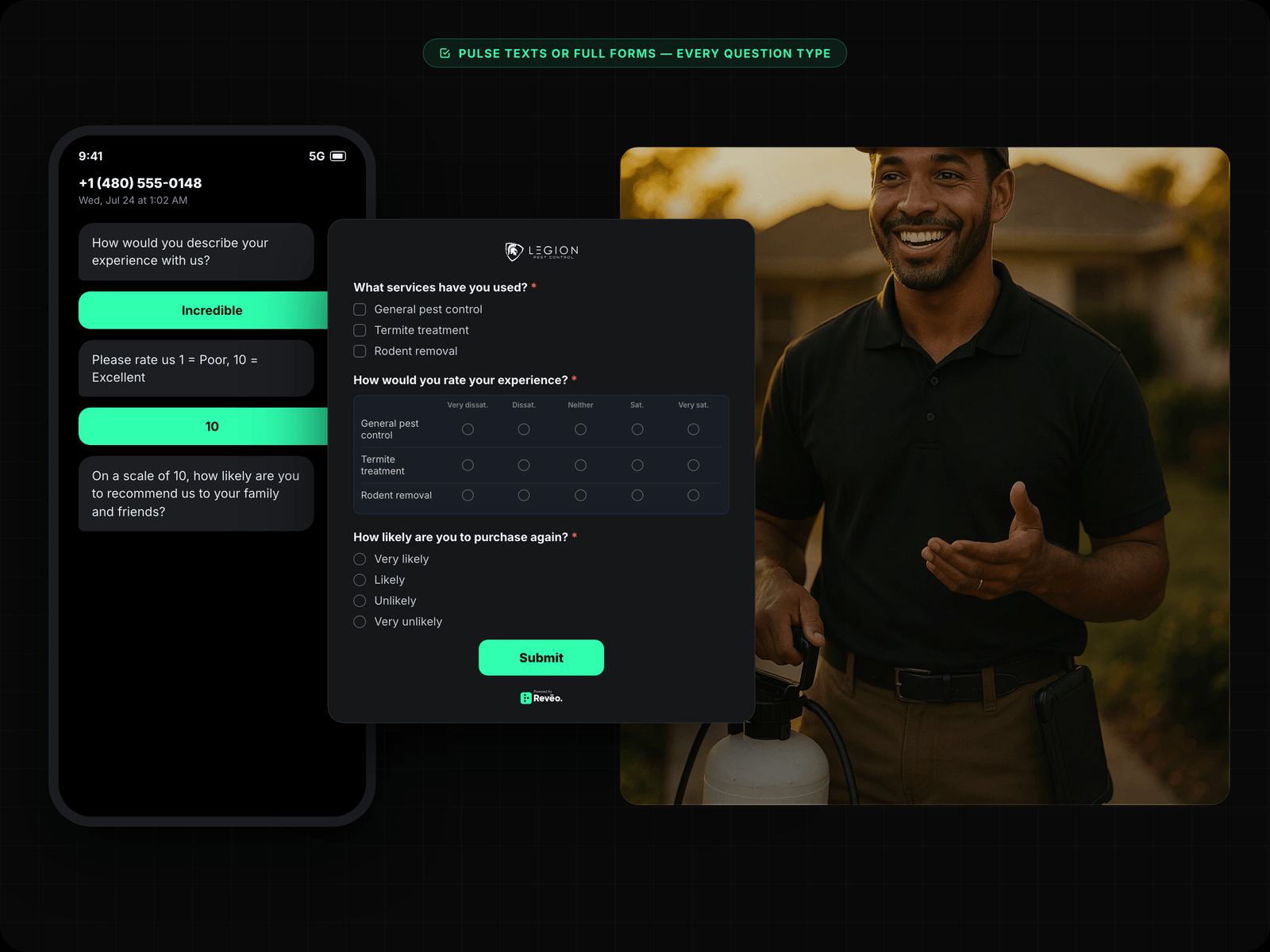
A good customer satisfaction survey asks one real question, right after the job, and makes it take ten seconds to answer. Most CSAT surveys fail for the opposite reason: they’re ten questions long, emailed a week late, and they measure who has time to fill out forms — not who’s actually happy.
Here’s the survey that works for a home service business, the exact questions to ask, and what to do with the answers so the survey earns its place instead of annoying your customers.
What a CSAT survey actually measures
CSAT — customer satisfaction score — measures how a specific job went, while it’s fresh. You ask a customer to rate the service they just got, usually on a 1-to-5 scale, and the score is the percentage who rated you at the top (a 4 or 5). That’s it. One number you can watch move week to week.
Don’t confuse it with NPS. Net Promoter Score asks about overall loyalty — “would you recommend us?” — which is a slower, relationship-level signal. CSAT is about the interaction that just happened: was the tech on time, did the leak stop, is the yard actually clean. For a business measuring job-by-job quality, CSAT is the one you want running.
The survey questions that actually work
Keep the whole thing to one screen. Here’s a survey a plumber or pest-control tech can send and a customer will actually finish:
1. The core rating (the only required question):
“How would you rate the service you got today?” (1–5)
That single question is your CSAT. Everything else is optional.
2. One open follow-up:
“Anything we could have done better?”
Leave it blank and optional. Most people skip it — but the ones who answer hand you the exact reason a job went sideways, in their own words. That comment is often worth more than the star rating.
3. One specific yes/no (pick one that matters to your trade):
“Did we leave the work area as clean as you’d expect?” “Did we show up inside the window we promised?”
Tie it to the thing your customers actually complain about. A cleaning company asks about the finish; an HVAC company asks about the arrival window. Generic “how was your experience?” questions get generic answers.
Three questions, one required. That’s the whole survey. Resist the urge to bolt on “how did you hear about us” and “rate our website” — every extra field drops your completion rate, and you can pull that data from your booking system instead. Need the actual invite message, not just the questions? 7 customer survey invite templates cover the send, not just the form.
Send it while the truck’s still in the driveway
Timing beats wording. A survey that lands within an hour of the job — while the customer remembers the tech’s name and the relief of the fixed problem — gets answered. The same survey sent five days later gets ignored, and the few responses you do get skew toward people annoyed enough to go dig up the email.
Text beats email for this. A one-tap link by SMS the moment the job is marked complete will out-respond an emailed form every time, because the customer’s already holding the phone. If you’re going to run a satisfaction survey at all, wire it to fire automatically on job completion — not as a task someone has to remember at the end of a long day.
The part most businesses skip: what you do with a low score
A survey you don’t act on is just a form. The whole point of asking is to catch a problem while you can still fix it.
Set it up so a low rating routes straight to you — a text or an alert — not into a spreadsheet nobody opens. If a customer rates the job a 2, you want to be calling them that afternoon, not finding out three weeks later when a public one-star shows up. Most unhappy customers never tell you they’re unhappy: researcher Esteban Kolsky found that for every one who bothers to complain, 26 stay silent and most just quietly leave. The survey is how you surface those 26 before they churn.
This is also the honest line between a recovery workflow and something shadier. Routing an unhappy answer to your team so you can fix the problem before it becomes a public review is good service. Using the survey to steer unhappy customers away from ever leaving a review — “review gating” — violates Google’s policy, and customers can smell it. Catch problems early; never hide them.
And when a customer rates you a 5? That’s your cue to ask for the public review, while they’re already telling you they’re thrilled. The same happy-customer moment powers both.
Make it run without you
Every part of this dies the same way: you get busy, the survey doesn’t go out, and you’re back to guessing whether your crews are doing good work. The businesses that actually use CSAT don’t send surveys by hand — they’ve made it automatic.
That’s what Reveo’s survey tools do: the moment a job is marked complete, Reveo texts a short satisfaction survey, scores the response, routes anyone unhappy straight to you for a quick save, and invites the happy ones to leave a review — all in one flow. You get a live read on how every job went without chasing a single form.
Start with one question. Send it at the wow. Act on the low scores fast, ask the happy ones for a review, and let the whole thing run in the background while you run the trucks.