

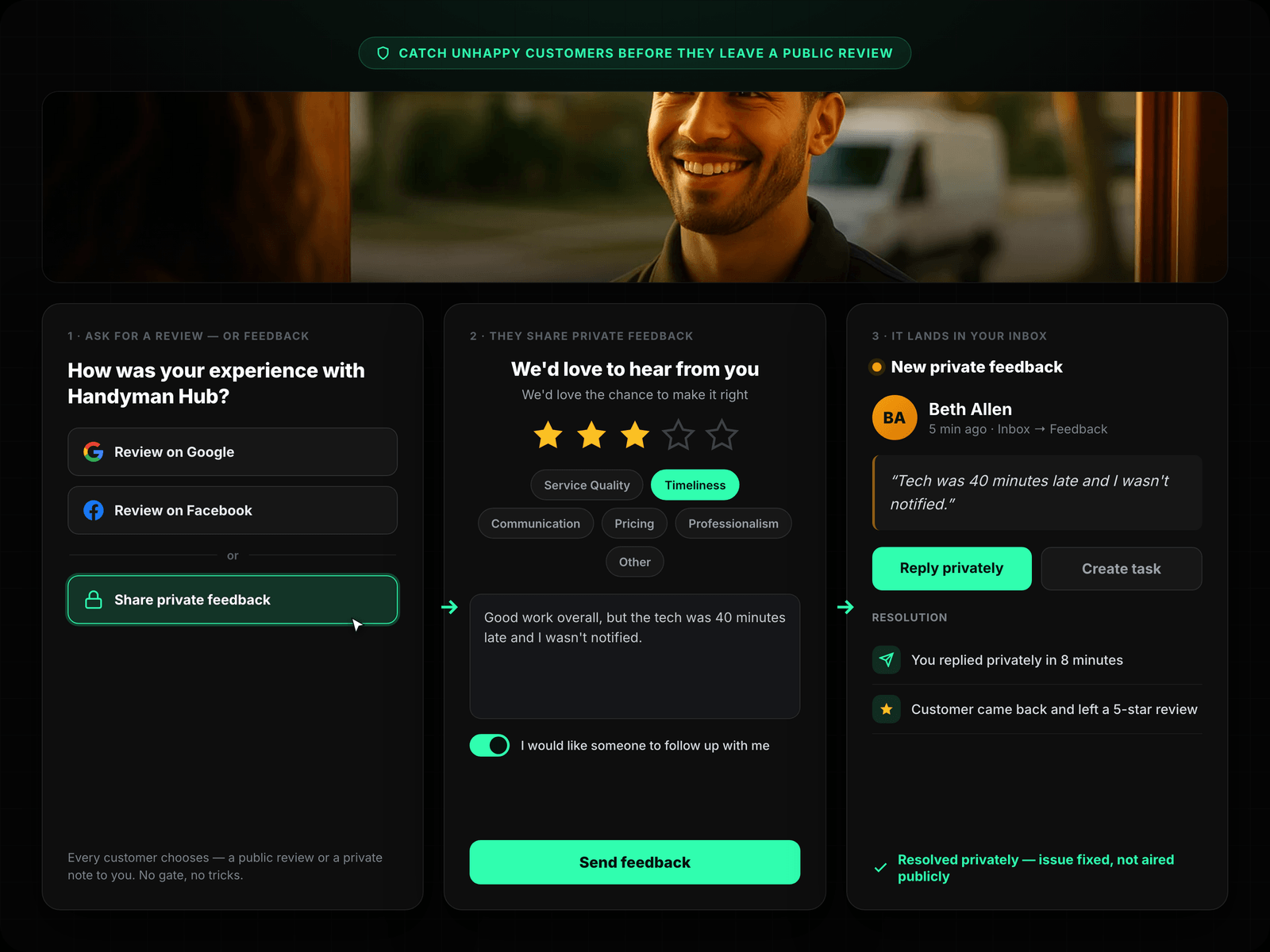
Private feedback and public reviews do two different jobs. A public review is a customer telling the world how the job went; private feedback is a customer telling you directly — before they decide whether to say anything in public at all. Give an unhappy customer a fast, private way to reach you and you get to fix the problem in hours, instead of reading about it in a 1-star review three days later.
That’s the honest case for a private feedback form, and it’s worth being precise about. It doesn’t hide a bad review or keep anyone quiet. Every customer can still leave a public review. A private feedback form just adds a faster lane straight to you.
Customer feedback vs reviews: what each one is for
Public reviews are your reputation. They’re what a stranger reads before they call you, and over time a steady stream of recent, responded-to reviews is one of the best assets a home-service business has.
Private feedback is your smoke detector. The tech left, something wasn’t right, and the customer is annoyed — but they haven’t posted anything yet. That gap between “annoyed” and “posted” is the most valuable window you get, and most businesses never see it. They find out something went wrong when the review is already live and a prospect is already reading it.
The point of collecting private feedback is to live inside that gap on purpose. Catch the problem while it’s a phone call, not a public rating.
The line this workflow does not cross
Because we do reputation for a living, we’ll say this plainly. A private feedback form is a recovery tool, not a filter. It is not review gating.
Review gating is sending only your happy customers to post publicly while diverting the unhappy ones somewhere private so their negative review never happens. Google discourages it, and a savvy customer can smell it. We don’t build that and we won’t tell you to.
What a compliant setup does instead: everyone gets the same easy path to a public review, and everyone also gets an easy way to reach you privately if something’s wrong. If an unhappy customer chooses to vent to you instead of to Google, that’s their choice — you’ve just earned the chance to fix it. Some will still post publicly, and that’s fine. This is the version that lasts, and it’s a better business anyway.
Send it in the same moment you ask for a review
You don’t need a second campaign for this. The private-feedback ask lives in the same message as your review request, right after the job closes while the experience is fresh.
One text does the whole job: a happy customer taps through to leave a public review, and an unhappy one taps through to tell you what went sideways. Same message, two doors. The customer picks the one that matches how they actually feel — you don’t decide for them.
Timing is most of the battle. A feedback request that lands within an hour of the job gets a real answer. One that shows up a week later gets ignored, and by then the frustrated customer has either moved on or already posted.
Keep the form to one or two questions
The mistake is treating this like a research project. You don’t need a 12-question survey; you need a heads-up. A rating and a single open box — “How did we do?” and “Anything we should know?” — is enough to surface the problem and give you a name and number to call back.
If you want to go deeper on structured measurement later, that’s what a proper customer satisfaction survey is for. For catching problems before they post, short wins. Every extra field is one more reason a busy, mildly-annoyed customer abandons the form and posts their complaint on Google instead.
The response is the whole product
Private feedback only works if you act on it fast. A form that collects complaints nobody reads is worse than nothing — you’ve told the customer you’re listening and then proved you weren’t.
Aim for hours, not days. Most negative experiences are recoverable if you reach the person while they’re still deciding how they feel about you. A quick call — “I saw your note, I’m sorry, here’s what we’re going to do” — often turns the customer who was about to torch you into one who quietly tells a neighbor you made it right. When a review does slip through to public, the same speed applies, so it’s worth knowing how to respond to Google reviews the right way.
Put it on autopilot
Every part of this dies the same way the referral ask does: you get busy, the moment passes, and the complaint you could’ve caught shows up as a public 1-star instead. The fix isn’t discipline — it’s a system that sends the ask every time without you remembering.
That’s what Reveo’s surveys and private feedback tools do. After a job, Reveo sends one message that routes a happy customer toward a public review and gives an unhappy one a private form straight to your inbox — then flags it so you can call them back the same day. Everyone keeps their path to a public review; you just stop finding out too late.
Set it up once. Catch the problems while they’re still a phone call, and let the good jobs speak for themselves in public. This is one piece of the full review management playbook — generation, monitoring, response, and repurposing, as one system.