

The business that answers first usually gets the job. Speed to lead — how fast you respond to a new inquiry — is the biggest predictor of whether that inquiry turns into a booked customer, and it costs nothing to fix.
Here’s the uncomfortable part. The lead who filled out your form at 7pm, or called while your crew was on a roof, is contacting your competitors too. They’re not loyal to you yet. They’re loyal to whoever picks up first and makes the pain go away. If you call back tomorrow morning, someone else already booked the job last night.
The math on being first
This isn’t a hunch. Harvard Business Review’s study of thousands of inbound leads found that companies that responded within an hour were nearly 7 times more likely to have a real conversation with a decision-maker than those who waited even one hour longer — and 60 times more likely than firms that waited a day or more.
And an hour is slow. A widely cited lead-response study found your odds of actually reaching a new lead drop off sharply after the first 5 minutes. Not the first day, or the first hour. Five minutes. After that, the person has moved on to the next name on their list, gotten distracted, or already talked to someone else.
Most home service businesses respond in hours, if they respond the same day at all. That gap is the opportunity. You don’t need better ads or a bigger marketing budget to win more of the leads you already get. You need to answer faster than the other guys.
Why the first responder wins the job
Two things happen when you respond fast, and both are worth more than they look.
First, you catch the customer while the problem is urgent. Someone with a leaking water heater or a wasp nest by the front door isn’t casually shopping — they want it handled now. Reach them in that window and price becomes secondary. Reach them tomorrow and they’ve had time to cool off, compare quotes, and second-guess.
Second, speed is proof. A business that texts back in two minutes signals it’ll show up on time and answer the phone when there’s a problem. A business that takes a day to reply signals the opposite. The customer is reading your response time as a preview of your service, and they’re usually right.
What “fast” actually means here
Fast is relative to your competitors, not to some abstract standard. If the other three plumbers in town all call back the next day, a same-hour response makes you look like the responsible one. But the real target is minutes, not hours — get inside that 5-minute window whenever you can.
The tradeoff worth naming: fast can’t mean careless. An instant autoreply that reads like a robot — “Your request is important to us” — is barely better than silence, because it doesn’t move the conversation forward. The goal is a fast reply that actually does something: confirms you got the request, answers the obvious first question, and offers a real next step. Speed and a human touch aren’t opposites. You just have to build for both.
The three leaks that kill your response time
Slow response time is rarely laziness. It’s almost always a system problem. Three leaks account for most of it.
Missed calls going to voicemail. A ringing phone during a job goes unanswered, the caller doesn’t leave a message, and that lead is gone — you don’t even know it existed. The fix is automatic: when you can’t pick up, a text goes out within seconds so the conversation stays alive. That’s the entire idea behind missed-call text-back, and for a lot of businesses it’s the single biggest recovery of lost leads.
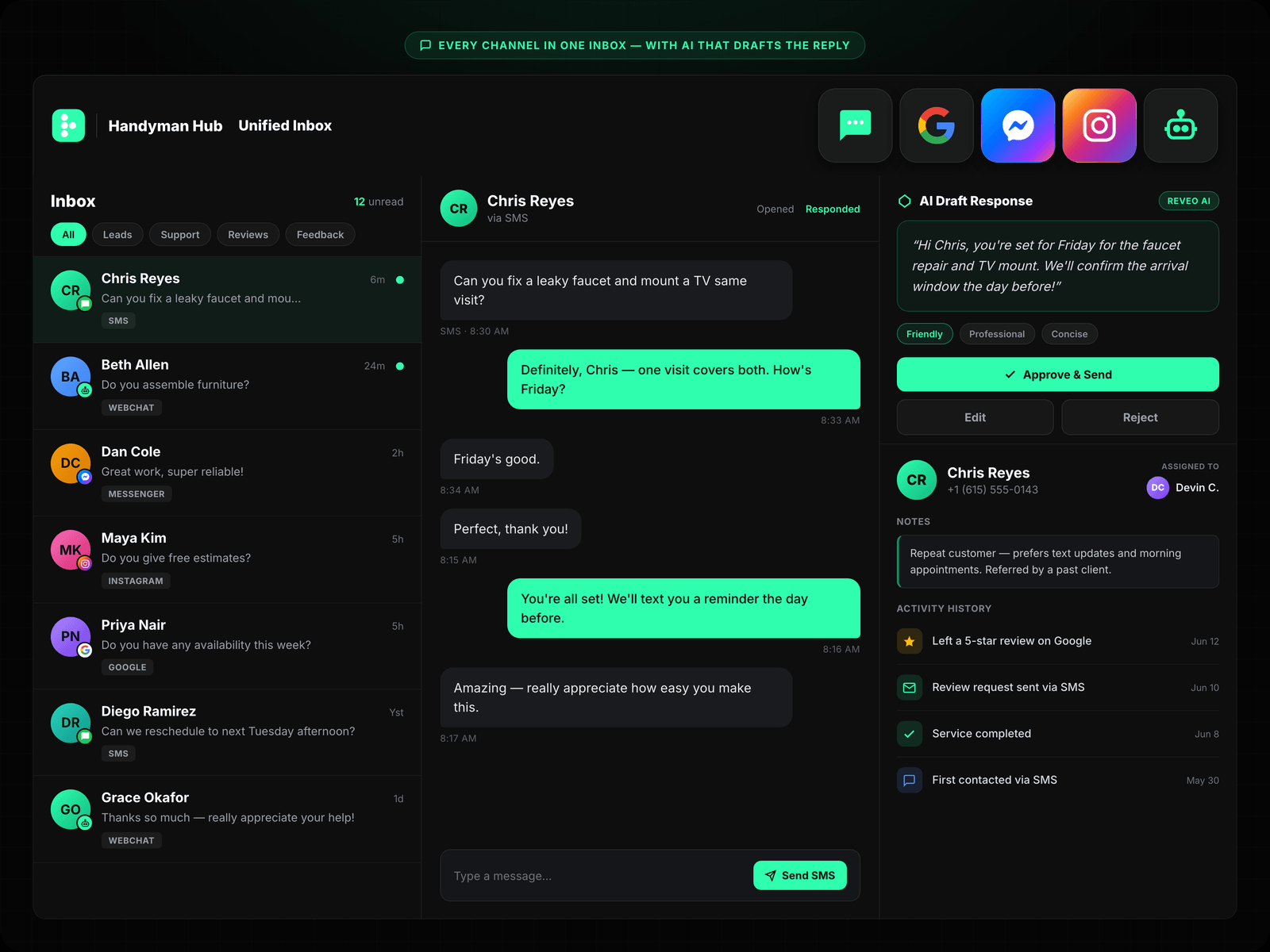
Leads scattered across five inboxes. A call here, a Facebook message there, a form fill in your email, a Google message you forgot you had. When new inquiries land in five different places, some of them sit for days before anyone notices. Pulling every channel into one unified inbox means nothing slips, because there’s only one place to watch.
After-hours inquiries with no plan. A big share of home service leads come in evenings and weekends, exactly when no one’s at a desk. If your plan is “we’ll get to it Monday,” you’re handing those leads to whoever answers on Saturday. An automated first reply buys you the time to follow up properly without losing the lead.
How to respond fast without living on your phone
You can’t beat your response time by trying harder or staring at your phone all day. You beat it by making the first response automatic, then following up as a human.
That’s what Reveo’s messaging tools are built to do. Every new lead — a missed call, a text, a webchat, a form fill — lands in one inbox, and Reveo can fire an instant, personal-sounding first reply the moment it arrives, so the customer hears back in seconds instead of hours. You and your team pick up the conversation from there, from your phone or a laptop, without hunting across apps to find where the lead came in. The customer feels answered right away, and you never lose one to a competitor who happened to be at their desk.
If you already send review requests by text after a job, this runs in the same lane — the same fast, on-brand messaging that wins you reviews also wins you the job in the first place.
Where to start
Pick your worst leak and close it first. If calls go to voicemail during jobs, turn on missed-call text-back — most businesses see the biggest jump there. If leads are scattered, get them into one inbox so nothing sits unseen. Then measure the one number that matters: how long, on average, from a lead landing to your first reply. Watch it drop, and watch more of the same leads you’re already paying for turn into booked work.
Speed to lead isn’t a growth hack. It’s just answering first, every time — and building the system so you do it whether or not you’re thinking about it.