

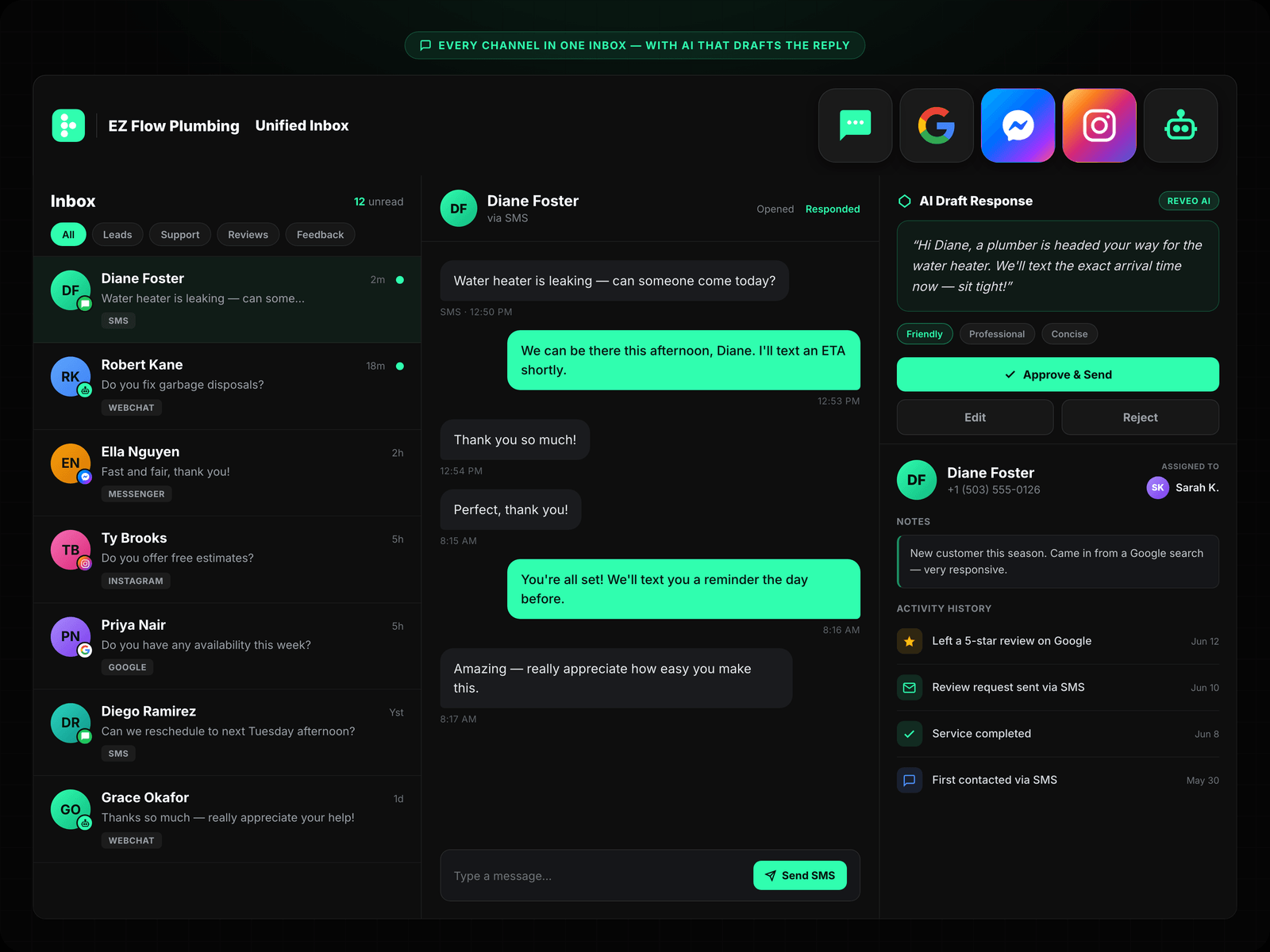
A missed call text-back sends an automatic text to anyone whose call you don’t answer — within seconds, from your business number — so the lead stays warm instead of dropping into a voicemail nobody checks. For a home-service business, it’s one of the highest-return automations you can turn on, because the call you just missed was almost always someone ready to book.
Think about who calls a plumber, an HVAC company, or a pest-control outfit. They’ve got a problem right now. If you don’t pick up — you’re under a sink, on a roof, driving between jobs — they don’t leave a patient voicemail and wait. They hang up and call the next number on the list. The Lead Response Management study found you’re 21× more likely to qualify a lead when you reach them in 5 minutes instead of 30. A voicemail you return that afternoon has already lost.
What missed-call text-back actually does
The mechanic is simple. A call comes in, it goes unanswered past a few rings, and the system fires a text to that number automatically — a short message from your business line acknowledging the call and asking how you can help. The customer texts back, and now you’re in a conversation you can answer from your phone between jobs, without playing phone tag.
That last part matters more than it sounds. A ringing phone demands you drop everything that second. A text sits and waits. You finish tightening the fitting, wash your hands, and reply — and the lead is still there because you answered in ninety seconds instead of ninety minutes.
The voicemail is where leads go to die
Here’s the uncomfortable math. Most missed calls at a busy service business never turn into anything — not because the customer didn’t want to buy, but because nobody closed the loop fast enough. Harvard Business Review found businesses that respond to a new lead within an hour are 7× more likely to reach a decision-maker than ones that wait even 60 minutes longer. Voicemail is the opposite of that. It’s a box you check when you get around to it.
This missed-call automation closes the gap the moment it opens. The customer who called at 2:14 gets a reply at 2:14. Even if you can’t talk yet, they know they reached a real business that’s paying attention — and they stop dialing around.
What the text should actually say
Keep it short, human, and useful. Sound like a busy pro who’ll take care of them, not a robot.
A version that works:
“Hi, this is Dave with [Company] — sorry we missed your call, we’re out on a job. Text me back what you need and I’ll get right to you. What’s going on?”
Notice what it does: it names a real person, explains the miss without apologizing three times, and ends with a question so the customer replies. “Please hold for the next available representative” energy kills it. So does a wall of links and hours-of-operation boilerplate nobody reads on a phone. One more line earns its place if you book online — a link to your scheduling page for the customer who’d rather just pick a time than trade texts.
Where this breaks if you set it up wrong
The honest tradeoff: an auto-text is only as good as what happens after it sends. Fire the text and then let the reply sit for two hours and you’ve made things worse — you promised attention and didn’t deliver. So the reply has to land somewhere you’ll actually see it, fast.
The other failure mode is texting people who weren’t leads at all — a supplier, your own tech, a robocaller. It’s minor, since they ignore it, but if you also take personal calls on the business line, set the automation to fire only during business hours, or only for numbers that aren’t already in your contacts. Small tuning, big difference in how spammy it feels.
Put it in one inbox, not another silo
The businesses that get this right don’t run texting as a separate app they forget to check. A pest-control company we work with handles tens of thousands of customers across its locations — missed-call texts, review replies, and inbound questions all land in the same place, so whoever’s on the phones sees every thread without hopping between five tools.
That’s the point of a shared team inbox for business messaging: the missed-call text isn’t a gimmick bolted on the side, it’s the front door of one conversation stream. Reveo’s two-way business messaging fires the text-back automatically, keeps every reply in one threaded inbox your whole team can answer from, and ties it to the customer’s history — so the person who calls back a week later isn’t a stranger.
If you want the strategy underneath all of this, it comes down to being the first business to respond. Missed-call text-back is just the cheapest way to win that race without thinking about it.
The one automation to turn on first
If you do nothing else this quarter, turn this on. It doesn’t need a new phone system, a receptionist, or a marketing budget — it needs the call you already miss to send a text instead of a shrug. Set the message, point the replies at an inbox you’ll actually watch, and stop letting voicemail spend your ad budget for you — so you never miss a lead you already paid to earn.