

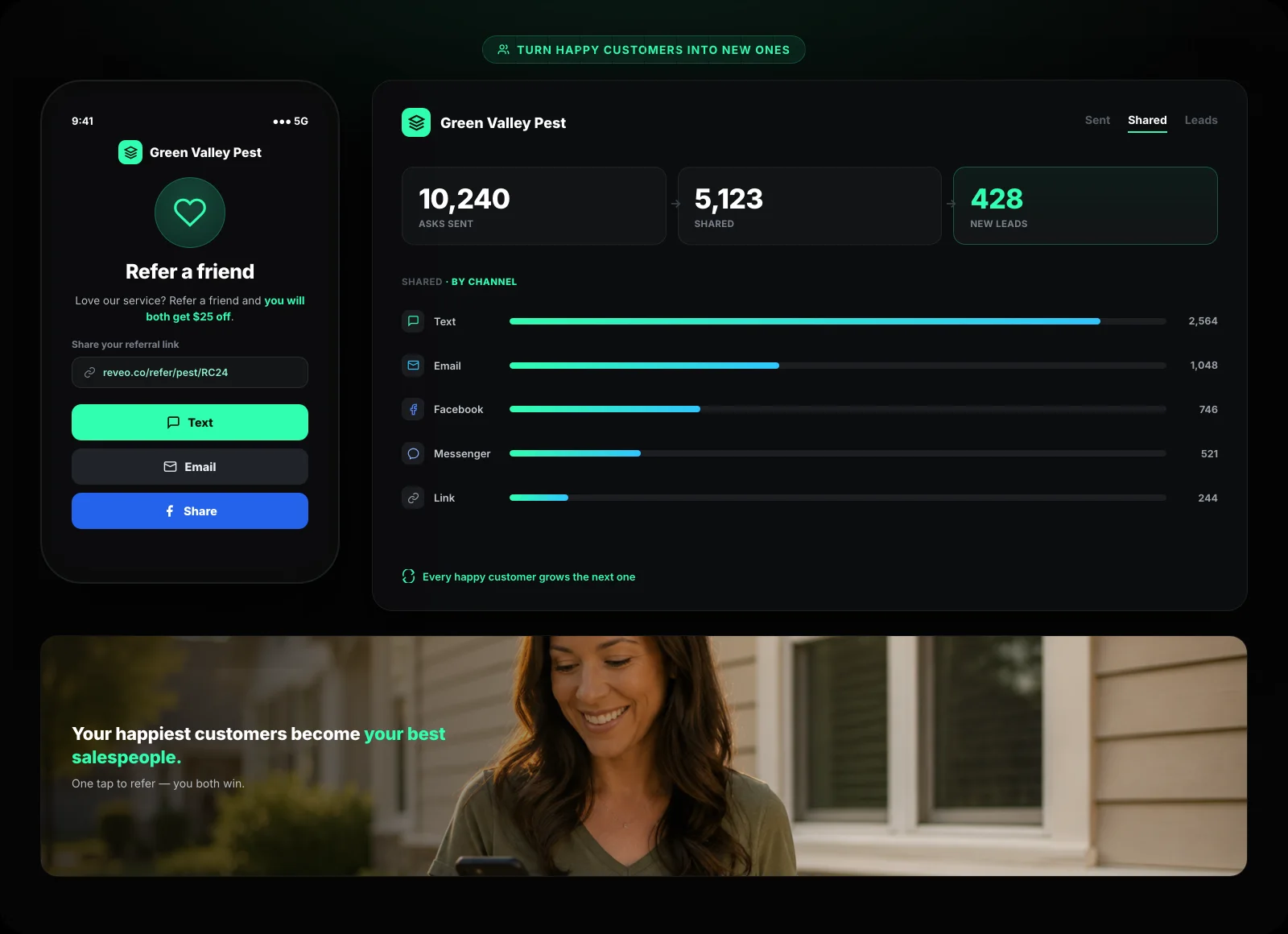
Most “referral programs” are just an owner hoping customers mention them at a barbecue. A real one is a system: it asks at the right moment, hands the customer a link, rewards the introduction, and tracks what came back — without you doing anything after you set it up.
That’s the difference between wishing for word of mouth and building a channel out of it. And it’s worth building, because a referred customer already trusts you: the hard part of the sale is done before you pick up the phone, and it costs about five times more to win a new customer than to keep or reactivate one you already have.
Here are the five pieces, and how to make them run on their own.
1. The offer — a clear reason to refer
Start with what the referrer and the new customer get. This can be nothing more than “you’ll be helping out a small business you trust,” and for a lot of home service companies that’s enough. If you want more participation, add a simple reward: a discount, a gift card, or account credit — for the referrer, the new customer, or both.
Keep it to one offer you can explain in a sentence. A points system you have to manage will cost you more time than it makes.
2. The ask — at the right moment
Timing is most of the battle. The referral you ask for right after a great job converts; the one you ask for cold, three weeks later, usually never comes. The best trigger is the moment a customer leaves you a 5-star review — they’ve just told you they’re happy, so the referral ask is the natural next sentence.
The mistake almost everyone makes is relying on memory to do this. You get busy, the moment passes, and the ask never happens. The fix is to make the ask automatic (see the last section). Not sure how to word it? 8 referral request templates give you a starting point for the text or email.
3. The link — make referring one tap
Even a customer who wants to refer you won’t if it’s work. “Go give my number to your neighbor” is friction. A personal link they can text or forward in two seconds is not.
Give every customer their own shareable link that opens your booking page or a simple “a friend recommended us” page — no app, no login for anyone. This one piece does more for participation than any reward, and it’s the one most businesses skip.
4. The reward — issued automatically
If you offer an incentive, it should be handed out the moment the referral pays off — when the new customer books — not whenever you get around to it. A reward that shows up late, or that the customer has to chase you for, teaches people the program isn’t real. Automating this is what keeps your advocates coming back.
One line worth repeating: reward the customer referral — someone bringing you a new customer. That is not the same as paying for reviews, which every platform prohibits. Keep the two clearly separate.
5. The tracking — so you know what’s working
If you can’t see who refers you and what those referrals are worth, you’re guessing. You’ll thank the wrong people and ignore your best advocates. At a minimum, track who referred whom, which referrals booked, and which handful of customers drive most of your word of mouth. Those few are worth a real thank-you and your attention.
Everything above is for past customers referring new ones. If your best referral source is professionals — realtors sending you their clients after an inspection or a repair need — that’s a different relationship to build. Here’s the mutual-referral playbook for working with realtors specifically.
Make it run without you
Every piece above dies the same way — you get busy and stop doing it by hand. A program that depends on your memory isn’t a program. The businesses that win at referrals have made the whole thing automatic.
That’s what Reveo’s referral tools do: after a customer leaves a 5-star review, Reveo automatically sends them their own referral link, issues any reward when the new customer books, and tracks every referral back to its source — running in the same flow as your review requests. You build the offer once; the asking, sharing, rewarding, and tracking happen on their own.
Set up the five pieces, wire them to run automatically, and your best customers turn into a steady, measurable source of new ones — no barbecue required.